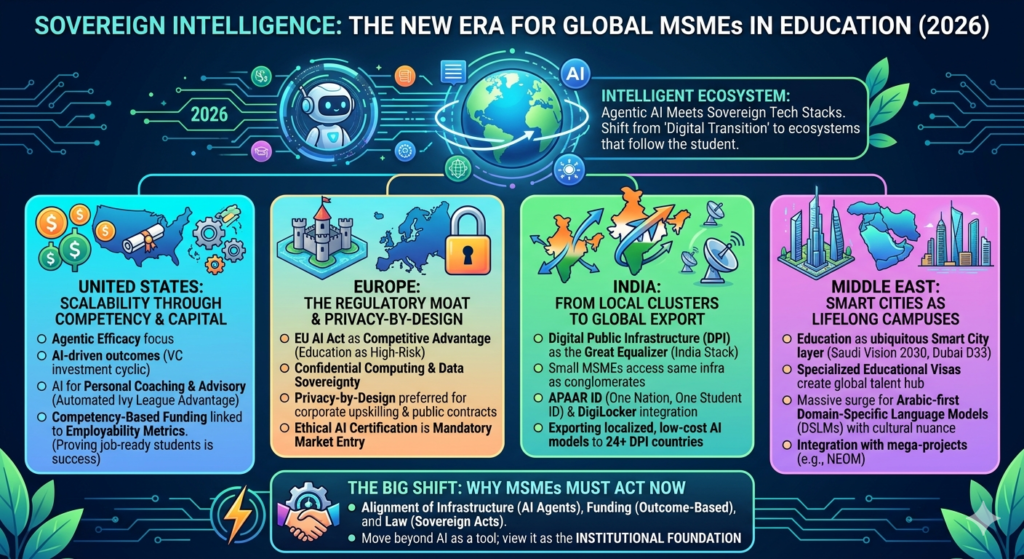
For the global MSME in education, the window of “digital transition” has officially closed. We have entered the era of Sovereign Intelligence. In 2026, the convergence of Agentic AI and rigorous regional policy has transformed education from a service you “log into” to an intelligent ecosystem that follows the student.
This isn’t merely about adopting new software; it’s about navigating a world where Domain-Specific Language Models (DSLMs) meet Sovereign Tech Stacks. For schools and universities, the “now” is defined by the ability to provide elite-level personalization while remaining anchored in local regulatory reality.
United States: Scalability through Competency and Capital
In the US, the narrative has shifted from “EdTech growth” to “Agentic Efficacy.” Following a $2.6 billion VC investment cycle in 2025 focused purely on AI-driven outcomes, US MSMEs are now scaling through Competency-Based Funding.
The strategy for American institutions is to leverage AI agents to automate student advisory and personalized coaching, the traditional “Ivy League” advantage at a fraction of the cost. However, this scalability is now tied to policy: US federal and state initiatives are increasingly linking funding to measurable employability metrics. For the MSME, success in 2026 means using AI not just to teach, but to prove that students are job-ready.
Europe: The Regulatory Moat and Privacy-by-Design
Europe has turned the EU AI Act into a competitive advantage. Because education is classified as a “High-Risk” AI application, the continent has developed a unique “Regulatory Moat.” European MSMEs are leading the world in Confidential Computing, ensuring that student data remains sovereign and protected.
The focus here is on Sustainability and Data Sovereignty. Institutions that adopt “Privacy-by-Design” are finding themselves the preferred partners for corporate upskilling and public-sector contracts. In 2026, being an “Ethical AI” provider is no longer a marketing slogan; it is a mandatory certification for market entry in the Eurozone.
India: From Local Clusters to Global Export
India is currently the world’s largest laboratory for Digital Public Infrastructure (DPI). With the full integration of the APAAR ID (One Nation, One Student ID) and over 9.5 billion documents issued via DigiLocker, the “India Stack” has leveled the playing field for MSMEs.
A small vocational institute in a Tier-2 city can now access the same population-scale infrastructure as a global conglomerate. This sovereign stack has made Indian EdTech inherently “export-ready.” By building on the Open Credit Enablement Network (OCEN), Indian education MSMEs are now exporting their localized, low-cost, high-efficacy AI models to over 24 countries that have adopted similar DPI frameworks.
Middle East: Smart Cities as Lifelong Campuses
Under the umbrella of Saudi Vision 2030 and Dubai’s D33 agenda, the Middle East has bypassed legacy educational models. Education is now treated as a ubiquitous layer of the “Smart City.” The introduction of specialized Educational Visas has turned the region into a global talent hub.
For MSMEs, the opportunity lies in AI Localization. There is a massive surge in demand for Arabic-first DSLMs that respect regional cultural nuances while integrating with NEOM and other mega-project infrastructures. In this region, the “campus” is the city itself, and the tech stack must be as ambitious as the architecture.
Summary of the Shift
The time is now because the infrastructure (AI Agents), the funding (outcome-based), and the law (Sovereign Acts) have finally aligned. The MSMEs that will thrive are those that stop viewing AI as a tool and start viewing it as the very foundation of their institutional identity.
TheTechAspect