
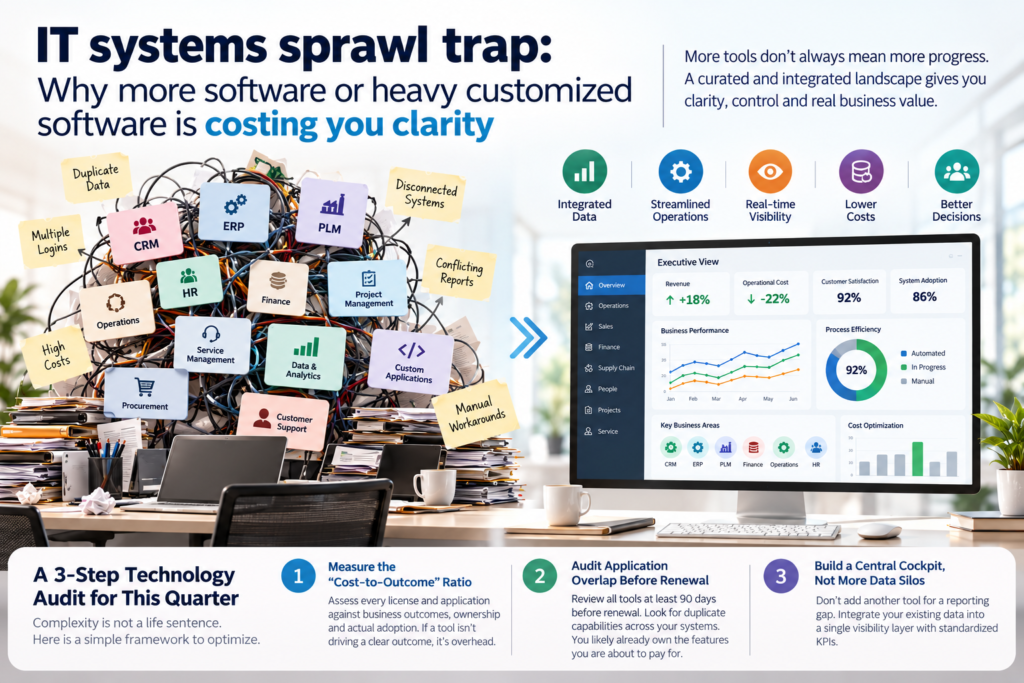
Why having bucket loads of enterprise software tools or a heavily customized internal tech stack often yields less operational clarity than having a curated integratred landscape.
For today’s CEOs, CFOs, CTOs and CIOs, technology is the engine of growth. But what happens when that engine becomes too complex to steer?
Organizations frequently acquire software reactively or build a shiny new tool themselves. A department needs a quick fix, a vendor does a brilliant demo, or internal IT team says they can build something faster and cheaper and then a new tool is deployed. Over time, this well-intentioned approach leads to application bloat, duplicate functionalities, disconnected databases, and climbing annual subscription costs or maintainence costs. Despite significant investments in these systems, leadership often receives conflicting data, and teams find themselves reverting to manual spreadsheet workarounds to bridge the gaps between tools.
This complexity comes from either ways : buying softwares vs building it themselves.
The Hidden Cost of Disconnected Systems whether SaaS off the shelf or Custom developed tools
Whether you are buying off-the-shelf SaaS products or building custom applications in-house, the hidden costs are the same: the direct cost of idle resources and the indirect cost of employee reconciliation time.
Couple of our clients highlighted their approach: The “Build-Everything” Approach.
Client has highly enthusiastic in-house IT team with under 5 years of experience. Driven by a desire to perfectly tailor their environment, they decided to custom-build almost all of their business applications mapped to their process one step at a time. This showcased immense technical capability, but it also inadvertently created an incredibly complex landscape with still manual processes.
Another client whom we consulted had similar approach more than 2 decades ago, driven by desire to perfectly tailor their environemnt with custom build solution, and was successful for a few years unless everything stopped working, tech advanced, systems were legacy, no maintenance, no vendor to take the handover.
In just a one-hour consultation, we were able to map out more than 17 distinct areas for strategic improvement. Rather than viewing these as “issues,” this is a ground for seeing in clarity a powerful roadmap for maturity. Some of the key opportunities :
- Bridging the Strategy Gap: Aligning the IT team’s output with a formalized, management-led technology roadmap.
- Alleviating Key-Person Dependency: Standardizing data and documentation so that the knowledge of their highly customized environment doesn’t sit with just a few members.
- Unblocking Business Change: Shifting away from building immediately a feature, rather evaluate the priorities on business process and its mapped IT capability, while being aligned with investment and return.
These situations are a perfect example of how rapid technology expansion, whether bought or built can outpace governance. But the good news? This is an entirely solvable problem, and addressing it unlocks massive value.
The Framework: A 3-Step Technology Audit for This Quarter
Complexity is not a life sentence. It is simply a signal that it is time to optimize. Here is a 3-step checklist business leaders can use to conduct a technology license and vendor audit this quarter:
1. Measure the “Cost-to-Outcome” Ratio Stop evaluating software (or custom builds) solely on uptime, cool feature sets, or sunk costs. Assess every license and application against direct business outcomes, accountable ownership, and actual active adoption by your team. If a tool isn’t driving a clear outcome, it’s just overhead.
2. Audit Application Overlap Before Renewal Don’t wait for the auto-renewal email. Establish a cross-functional governance review at least 90 days prior to contract renewals. Look specifically for duplicate capabilities across your CRM, ERP, and project tracking tools. You likely already own the features you are about to pay a new vendor for.
3. Build a Central Cockpit, Not More Data Silos When you encounter a reporting gap, the instinct is often to buy a new point solution or build a new custom dashboard from scratch. Instead, focus on integration. Connect your existing operational data into an executive visibility layer with standardized KPIs.
Moving Forward with Clarity
Whether you are navigating SaaS sprawl or a well-intentioned “build-everything” IT culture, the path forward isn’t about pointing fingers, it’s about taking stock. Every overlapping tool and custom bottleneck is a quantifiable opportunity to reduce costs, increase operational clarity, and empower your teams to do their best work.
Ready to find out where your organization stands? Let’s map your opportunities together. We partner with businesses to exactly understand where they stand and what they should look into, and we are there for them in every step.
– THE TECH ASPECT