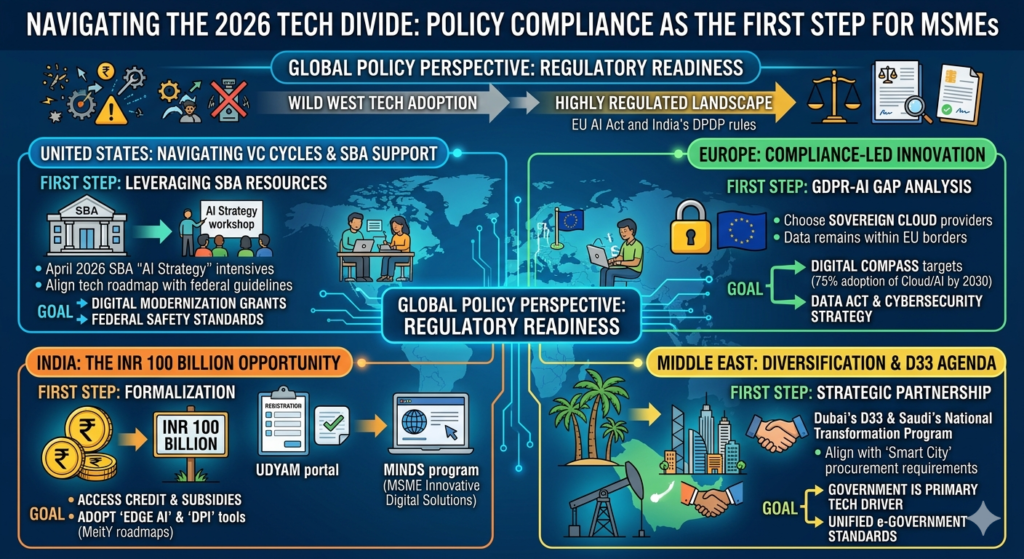
From a global policy perspective, the first step for MSMEs is Regulatory Readiness. We are moving from a “Wild West” era of tech adoption to a highly regulated landscape. Whether it’s the EU AI Act or India’s Digital Personal Data Protection (DPDP) rules, your technology strategy is now a compliance strategy.
United States: Navigating VC Cycles and SBA Support
In the US, the first step is leveraging SBA (Small Business Administration) Resources. In April 2026, the SBA is hosting nationwide “AI Strategy” intensives. The first move for a US firm is to align its tech roadmap with these federal guidelines to qualify for “Digital Modernization” grants and to ensure their AI usage meets evolving federal safety standards.
Europe: Compliance-Led Innovation
In Europe, the first step is a GDPR-AI Gap Analysis. European MSMEs must ensure that their “Digital Compass” targets (aiming for 75% EU firm adoption of Cloud/AI by 2030) don’t conflict with sovereignty rules. The first step is choosing “Sovereign Cloud” providers that guarantee data remains within EU borders, satisfying both the Data Act and the Cybersecurity Strategy.
India: The INR 100 Billion Opportunity
The Indian government’s 2026-27 Union Budget has allocated INR 100 Billion specifically for MSME tech upgrades. The first step for an Indian MSME is Formalization. By registering on the Udyam portal and participating in the “MINDS” (MSME Innovative Digital Solutions) program, businesses can access the credit and subsidies necessary to adopt the “Edge AI” and “DPI” tools mentioned in recent MeitY roadmaps.
Middle East: Diversification and the D33 Agenda
In the Middle East, the first step is Strategic Partnership. Under Dubai’s D33 and Saudi’s National Transformation Program, the government is the primary driver of tech demand. The first step for an MSME is to align its service offering with the “Smart City” procurement requirements, ensuring its digital infrastructure is compatible with the region’s unified e-Government standards.